


Long-term asset tracking requires more than accurate positioning. For vehicles, luggage, packages, and other mobile assets, frequent charging or battery replacement can increase maintenance work and interrupt tracking programs. Therefore, extended standby capability has become an important consideration when selecting wireless tracking equipment for commercial applications. A 3-year standby battery GPS tracker can support longer deployment periods while reducing the need for regular physical maintenance.
Why Battery Life Matters in Asset Tracking
Battery performance directly affects how practical a wireless tracker is for long-term deployment. When a device is installed on an asset that moves frequently or is difficult to access, repeated charging can become inconvenient and may create gaps in monitoring. Moreover, longer standby operation allows tracking devices to remain deployed for extended periods without requiring frequent intervention.
For commercial fleets and logistics operations, this advantage becomes even more relevant. A tracking program may involve dozens or hundreds of vehicles or assets, making routine battery management increasingly time-consuming. Consequently, equipment with an extended standby design can simplify deployment planning and support more consistent asset visibility.
Long Standby Supports Flexible Deployment
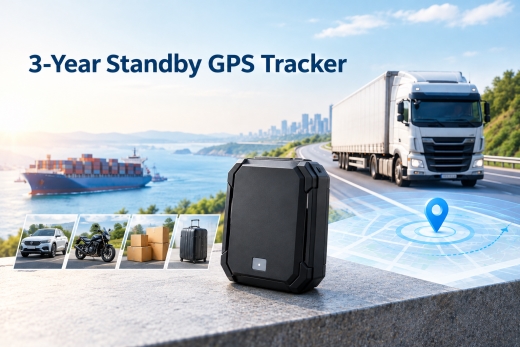
A major benefit of extended battery endurance is deployment flexibility. Trackers can be placed on vehicles, motorcycles, packages, luggage, or other movable assets without relying on a permanent external power connection. As a result, businesses can use wireless tracking equipment in situations where wired installation would be inconvenient or unsuitable.
The CW05 is promoted as a wireless GPS locator with up to three years of standby capability. However, the actual standby duration depends on operating conditions and configuration. Reporting intervals, positioning frequency, cellular communication, signal strength, and battery condition can all affect power consumption. Therefore, businesses should confirm the manufacturer’s test conditions before treating the advertised standby period as an expected result for every deployment.
Key Benefits for Long-Term Tracking
- Reduced maintenance: Longer standby operation can reduce the frequency of battery-related service tasks.
- Flexible installation: Wireless deployment supports assets without a permanent external power connection.
- Longer deployment cycles: Devices can remain in place for extended periods when configured for low-power operation.
- Lower operational workload: Fewer physical service visits can simplify asset management.
- Scalable monitoring: Extended standby capability can help businesses manage larger groups of movable assets.
How 4G Connectivity Supports Continuous Monitoring
Battery life is only one part of a tracking device’s overall performance. A tracker also needs dependable communication to transmit positioning information to a monitoring platform. The CW05 product page lists 2G&4G SIM-card connectivity and GSM frequency support at 850, 900, 1800, and 1900 MHz. However, these GSM bands do not identify the specific 2G&4G bands supported by the device, so buyers should confirm network compatibility for their target markets before deployment.
In addition, the CW05 uses the Zhongkewei AT6558R positioning module with GPS and BeiDou satellite positioning. The published specifications list an average cold-start time of 32 seconds, an average hot-start time of one second, and tracking sensitivity of -162 dBm. Together, these functions provide a positioning foundation for vehicle and asset monitoring, while actual performance can vary with satellite visibility and environmental conditions.
Hardware Specifications and Environmental Conditions
When choosing tracking equipment, businesses should evaluate the hardware alongside its intended deployment environment. The CW05 product information lists a compact ABS housing, a built-in positioning antenna, and a USB 5V charging port. Its published operating temperature range is -20°C to 75°C, while its storage temperature range is -30°C to 80°C. The listed operating humidity range is 5%–85% RH, non-condensing. These limits help buyers assess whether the device is suitable for their expected storage and operating conditions.
| Hardware Parameter | Published Specification |
|---|---|
| Product model | CW05 |
| Main product dimensions | 79 × 33 × 16 mm |
| Housing material | ABS plastic |
| Listed battery | 60 mAh, 3.7V polymer battery |
| Listed GSM bands | 850 / 900 / 1800 / 1900 MHz |
| Network description | 2G&4G SIM card |
| Positioning module | Zhongkewei AT6558R |
| Positioning method | GPS + BeiDou |
| Average cold-start time | 32 seconds |
| Average hot-start time | 1 second |
| Tracking sensitivity | -162 dBm |
| Operating temperature | -20°C to 75°C |
| Storage temperature | -30°C to 80°C |
| Operating humidity | 5%–85% RH, non-condensing |
| External interface | USB 5V charging port |
| IP rating | Not specified in the available product information |
Waterproofing and battery-life note: The available CW05 specifications do not confirm an IP rating, so water or dust resistance should not be assumed. The product page also lists an optional 180 mAh battery in its detailed specifications, in addition to the 60 mAh battery shown in the product overview. The battery configuration, housing dimensions, and exact conditions required to achieve three-year standby should be confirmed with the manufacturer before publication or purchase.
Positioning Accuracy for Vehicles and Assets
Accurate location information is essential when tracking valuable or mobile equipment. A positioning module allows businesses to identify where an asset is located and monitor changes in its movement over time. Furthermore, GPS and BeiDou support can provide location data for applications that require regular tracking updates.
The CW05 is designed for vehicle and asset management, making it relevant to commercial fleets, logistics operations, and other tracking scenarios. VSGPS presents this type of equipment for practical monitoring needs across multiple asset categories. Therefore, businesses can assess the device according to their own location-reporting requirements, network coverage, and deployment conditions.
Comparing Tracking Requirements
Different assets have different monitoring needs, so battery endurance should be considered alongside usage patterns and environmental conditions.
| Tracking Requirement | Potential Advantage | Suitable Scenario |
|---|---|---|
| Infrequent asset access | May reduce battery maintenance | Stored equipment and assets |
| Mobile vehicle tracking | Supports wireless deployment | Commercial fleets |
| Logistics monitoring | Helps maintain location visibility | Packages and transportation |
| Multi-asset management | Can simplify device servicing | Fleet and asset programs |
| Variable operating environments | Published temperature limits aid suitability checks | Vehicles and movable assets |
Applications for Long-Term Asset Management
Extended battery operation can be useful across several commercial tracking scenarios. Vehicle operators can use wireless trackers to maintain location visibility without relying on a permanent external power connection. Similarly, logistics companies can monitor packages and transportation assets during different stages of movement. In addition, luggage, motorcycles, and other movable property may benefit from compact tracking equipment when direct access to power is limited.
However, battery duration and location-reporting performance depend on operating conditions, network activity, reporting frequency, and the selected battery configuration. Businesses should also consider whether the installation environment exposes the tracker to rain, dust, or other conditions that require a verified IP rating. Confirming these details before deployment helps prevent mismatches between product capabilities and operational requirements.
Choosing a Tracker for Long-Term Deployment
When selecting tracking hardware, businesses should evaluate the complete operating environment instead of focusing on one specification. Battery endurance, network compatibility, positioning capability, installation method, operating temperature, and environmental protection all influence the suitability of a device. Moreover, the expected movement frequency of the asset can affect power consumption during real-world operation.
A well-matched tracking device can reduce routine maintenance while maintaining useful location visibility. Therefore, long-standby equipment is particularly relevant for organizations managing distributed assets where frequent physical servicing would be inefficient. Buyers should confirm the supported cellular bands, battery option, IP rating, and standby test conditions with the supplier before finalizing their requirements.
A Practical Approach to Extended Asset Tracking
Long battery endurance can change how businesses manage tracking programs. By reducing the need for frequent charging and maintenance, a 3-year standby battery GPS tracker can support longer deployment cycles for vehicles, logistics assets, and other movable equipment. Combined with cellular connectivity and GPS/BeiDou positioning, the CW05 provides a foundation for wireless asset monitoring.
Overall, battery life should be considered as part of a broader tracking strategy rather than as an isolated specification. When extended standby capability is matched with suitable connectivity, verified environmental protection, and appropriate positioning settings, businesses can build a more manageable approach to long-term asset tracking.