


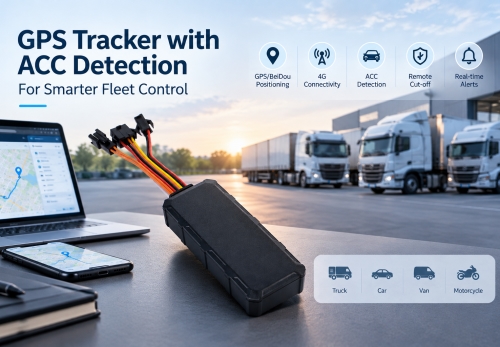
Modern fleet management requires more than knowing where vehicles are located. Fleet operators also need to know when vehicles start, stop, or remain active so they can coordinate operations effectively. Therefore, ignition monitoring helps commercial fleets manage trucks, cars, and other assets more efficiently. A GPS tracker with ACC detection combines ignition signals with location data, helping fleet managers respond to operational changes with better context.
Why ACC Detection Matters in Vehicle Tracking
ACC detection monitors ignition status through the vehicle’s ACC connection. As a result, fleet managers can distinguish active vehicles from parked or inactive units. Moreover, GPS positioning adds context to ignition data because location alone cannot always explain vehicle activity. For example, a truck may stay in one location while loading goods, waiting for instructions, or remaining unused.
Combining Ignition Status with GPS Positioning
A GPS tracker with ACC detection combines vehicle status with positioning information. When the ignition status changes, the tracker can associate the event with the vehicle’s location and communication status. Furthermore, GPS and BeiDou dual-mode positioning support location tracking, while 4G connectivity transmits data over supported networks. Consequently, fleet operators can review vehicle movements and operating patterns more effectively.
Key Benefits for Fleet Management
- Clearer vehicle activity: ACC status helps distinguish active vehicles from parked units.
- Better dispatch visibility: Operators can compare vehicle locations with ignition status.
- More useful event records: Ignition changes add context to GPS tracking data.
- Improved fleet oversight: A centralized platform helps operators monitor multiple vehicle conditions.
- Vehicle control support: ACC detection works alongside an external relay in suitable control applications.
How ACC Monitoring Supports Fleet Efficiency
Ignition monitoring helps operators identify patterns that GPS coordinates alone may not explain. For instance, unexpected ignition activity may require further review, while long periods of inactivity can reveal delays or underused vehicles. In addition, vibration, overspeed, and low-voltage alarms provide more information about vehicle events. By reviewing these signals together, fleet managers can better understand operating conditions and make informed decisions.
4G and Dual-Mode Positioning for Commercial Vehicles
Reliable communication helps fleet operators track commercial vehicles across different operating areas. The VS03-8 supports 4G connectivity and GPS/BeiDou positioning for connected fleet monitoring. Its LTE-FDD bands include B1/B2/B3/B4/B5/B7/B8/B28/B66, while its GSM bands cover 850/900/1800/1900 MHz. Furthermore, the DC 9–95V operating voltage range accommodates a broad range of vehicle electrical environments, and the ABS housing provides a practical enclosure for commercial installations.
| Feature | Specification |
|---|---|
| ACC detection | One ACC detection port |
| Network | 2G/4G SIM card; CAT 1 |
| LTE frequency bands | LTE-FDD B1/B2/B3/B4/B5/B7/B8/B28/B66 |
| GSM frequency bands | 850/900/1800/1900 MHz |
| Positioning | GPS + BeiDou; AT6558R module |
| Operating voltage | DC 9–95V |
| Operating temperature | -20°C to 75°C |
| Storage temperature | -30°C to 80°C |
| Operating humidity | 10%–85% RH, non-condensing |
| Dimensions and weight | 79 × 33 × 16 mm; 40 g |
| Housing | ABS plastic |
| IP rating | Not specified in the available specifications |
Supporting Different Fleet Applications
A GPS tracker with ACC detection supports a range of commercial vehicle scenarios, including pickup trucks, trucks, rental vehicles, service vehicles, and other mobile assets. Meanwhile, operators can also consider motorcycle applications when the hardware and installation method suit the vehicle. By combining movement data with ignition status, fleet managers gain a clearer picture of vehicle activity instead of relying on location records alone.
Remote Control and Event Monitoring
Fleet operators can expand tracking functions by combining positioning and ignition information with additional interfaces. For example, the VS03-8 connects to an external relay for oil or power cutoff applications, and its interface can support an external SOS button. In addition, vibration, overspeed, and low-voltage alarms provide further event information. Together, these functions help fleet operators manage vehicle visibility and selected control tasks through a connected tracking setup.
Power, Standby, and Installation Considerations
The VS03-8 draws vehicle power across a DC 9–95V input range and supports an optional 60mAh, 3.7V polymer battery. However, the available specifications do not state a guaranteed standby duration or define the reporting interval and test conditions for a specific standby time. Therefore, operators should confirm these details with the manufacturer before making multi-year standby claims. Actual backup duration varies with the battery configuration, reporting activity, network conditions, and installation.
The available specifications also do not list an IP protection rating. Consequently, fleet operators should not assume that the device offers waterproof or dustproof protection. Before installation, they should confirm the required environmental protection and follow the device’s wiring instructions for the ACC connection and external relay.
Choosing a Tracker for Commercial Fleet Use
When selecting tracking hardware, fleet operators should compare communication bands, positioning capabilities, electrical compatibility, environmental limits, and monitoring functions. Moreover, they should check whether the device fits their installation requirements and daily workflows. VSGPS offers the VS03-8 as an 8-pin GPS locator for commercial and fleet applications, with configuration options for different project needs. Therefore, ACC monitoring can form part of a broader vehicle management strategy.
Conclusion
Effective fleet control depends on understanding both vehicle locations and operating status. By combining ACC detection with GPS/BeiDou positioning, 4G connectivity, event alerts, and suitable vehicle interfaces, operators can gain more useful information from their tracking infrastructure. Ultimately, the VS03-8 supports more informed commercial fleet monitoring when operators confirm its installation and environmental requirements before deployment.